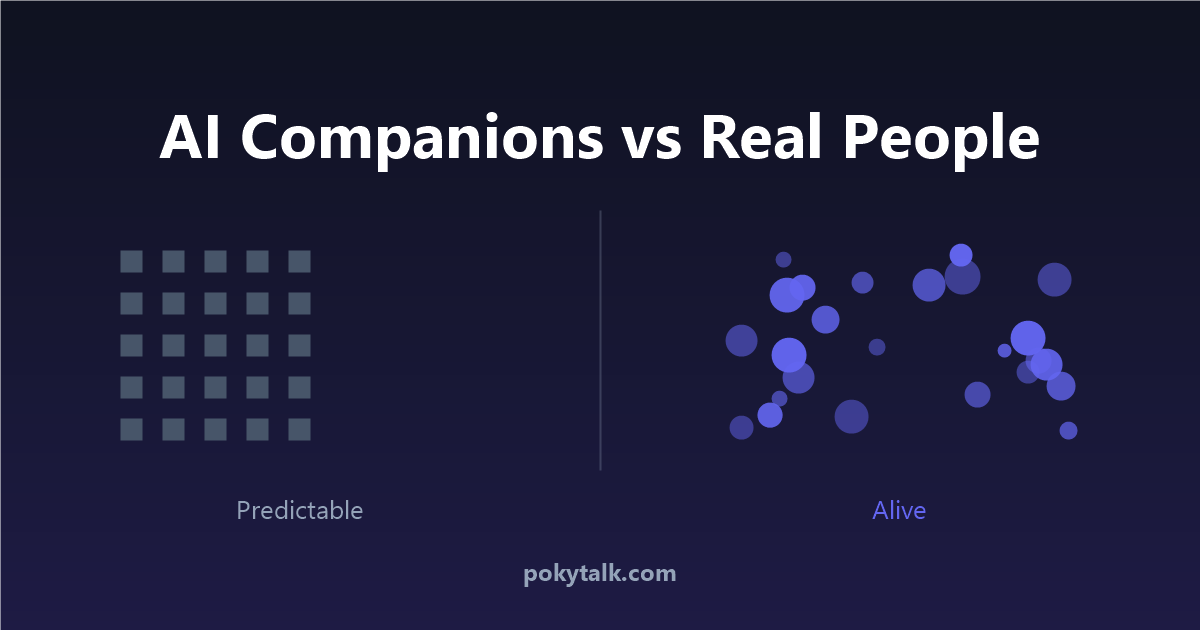
AI Companions vs Real People: Why Human Voice Still Matters
Something changed quietly over the last couple of years. Talking to a machine stopped being a novelty. AI companions now have natural voices, remember what you told them last week, and are available at three in the morning when nobody else is. For millions of people they have become a genuine part of daily life — not a gimmick, but the thing they actually talk to.
It is worth being honest about why. AI companions are good at something real, and pretending otherwise is how you end up with a bad argument. But there is a specific thing they cannot do, and it is not a small thing. This article is about what that is, why it matters, and what to do if you have noticed that most of your conversations lately have been with software.
Why AI companions feel so good
Start with the steelman, because the appeal is not irrational.
They never reject you. An AI will not sigh, check its phone, or decide you are boring. Every message you send lands. If you have ever been genuinely lonely, you know how much that is worth.
They are always available. Human friendship runs on scheduling. AI runs on nothing — no timezone, no busy week, no sense that you are imposing.
They have infinite patience for your specific thing. The obscure game, the niche anxiety, the same worry for the fifth night running. Friends get tired. AI does not.
There is no risk. No chance of saying something stupid that gets remembered. No social cost. Nothing to lose.
That last one deserves a closer look, because it is simultaneously the strongest selling point and the entire problem.
The thing that cannot be simulated
Here is a question worth sitting with: when an AI tells you that you are interesting, what has actually happened?
Nothing was risked. Nothing was chosen. A system built to be agreeable was agreeable. It could not have concluded otherwise, because there is no version of it that gets bored and leaves. The compliment is real in the sense that you received it, and empty in the sense that it cost nothing and could not have gone another way.
Now consider a stranger on a voice call who has no reason to be kind to you, could hang up at any second, and stays on for forty minutes anyway because the conversation is good. That is information. Something was genuinely at stake and the outcome could have been different.
This is the part that does not transfer. Being valued only means something when the other party had a real option not to. Remove the possibility of rejection and you remove the meaning of acceptance along with it. You cannot keep one and discard the other — they are the same mechanism viewed from two directions.
The same is true of being changed by someone. Real people push back. They have opinions formed by lives you have not lived, and sometimes they tell you that you are wrong in a way that sticks. An AI trained to be helpful will mostly follow you where you lead. You can talk to one for a year and come out with the same views, somewhat more confident. That is not a conversation, it is a mirror with good manners.
Reciprocity is the missing ingredient
Notice that AI conversation is structurally one-directional. You bring your day, your problems, your interests. It responds to all of it. It never needs anything back.
That sounds like a feature. It is actually why the interaction feels subtly hollow even when each individual reply is good. Human closeness is built on mutual obligation — you listen to their bad week, they listen to yours, and the debt runs in both directions. Being needed is not a tax on friendship, it is a load-bearing part of it.
An AI cannot need you. So the muscle you use to notice what someone else is carrying, to ask the follow-up question, to be useful to another person, simply does not get exercised. Left alone long enough, that skill fades. People report exactly this: after months of frictionless AI conversation, real ones feel exhausting and demanding by comparison.
They have not become harder. You have become less practised.
Where AI genuinely helps
It would be dishonest to end the fairness there. There are real cases where AI conversation is clearly good:
- Rehearsal. Practising a hard conversation — a resignation, a confrontation, coming out to family — before having it with the person who matters.
- Language drilling. Repeating a phrase thirty times without embarrassment is genuinely easier with a machine. Though for the part that actually makes you fluent, see our guide on practising with native speakers.
- Getting through a bad night. Something responsive at 4am is better than a ceiling. Nobody should feel guilty about that.
- Accessibility. For people whose social anxiety or circumstances make human contact genuinely difficult right now, AI can be a real bridge rather than a replacement.
The distinction that matters is not AI versus humans. It is bridge versus destination. AI is a reasonable place to warm up. It is a bad place to stay, and the reason is simple: it is the only relationship in your life that cannot be disappointed in you, which means it is the only one that cannot help you grow.
What the research does and does not say
A note on evidence, because this topic attracts confident claims in both directions.
Loneliness itself is well documented as a serious health issue — the World Health Organization treated it as a public health priority significant enough to convene a Commission on Social Connection, and the link between social isolation and poor physical and mental health outcomes is one of the more robust findings in the field.
The specific effects of AI companions, however, are genuinely new territory. The studies are early, the timeframes are short, and the results are mixed: some find short-term reductions in reported loneliness, others raise concerns about dependence and displacement of human contact. Anyone telling you the science is settled here is overselling it, in either direction.
What we can say with more confidence is the older, better-established finding: brief interactions with strangers reliably lift mood, and people consistently underestimate how much they will enjoy them beforehand. That gap between expected and actual enjoyment is one of the more replicated results in social psychology, and it is the practical reason the advice below is worth trying even when it sounds unappealing.
Why voice is the right place to start again
If you want to rebuild the habit, voice does more work than text.
Text is where AI is most convincing, because text is where humans are least distinguishable from a good language model. Voice is different. You hear someone searching for a word. You hear them almost interrupt and stop themselves. You hear the difference between polite laughter and the real kind. Those cues arrive automatically and they are hard to fake in real time.
Voice also removes the editing. In a message you can draft, delete and optimise yourself into someone slightly fictional. On a call you say the slightly wrong thing and keep going, which is both more uncomfortable and much closer to how actual relationships work. We go into the format differences in more depth in voice chat versus text chat.
Practical steps if AI has become your main conversation
No guilt required — this is a very easy pattern to fall into. Some things that actually help:
- Aim for one real conversation a week, not a transformation. Ambitious targets fail. One is enough to keep the skill alive.
- Use low-stakes strangers first. Anonymous voice chat is genuinely easier than messaging a friend you have gone quiet on, because there is no history to explain and no relationship to damage.
- Let it be mediocre. Some calls go nowhere. That is not failure, it is the base rate. AI has quietly trained you to expect every exchange to be satisfying, and real conversation does not work that way.
- Practise asking, not just answering. The reciprocity muscle is the one that atrophied. Ask one genuine follow-up question per conversation and you will rebuild it faster than anything else.
- Keep the AI for what it is good at. Rehearsing, drafting, drilling vocabulary. This is not about deleting anything.
If you are not sure what to actually say, our list of 50 conversation starters exists for exactly this, and handling awkward moments covers the part everyone is actually afraid of.
The short version
AI companions solve loneliness the way a photograph of food solves hunger. The resemblance is genuinely close, the experience is genuinely pleasant, and the thing you actually needed did not happen.
What you needed was for someone with their own life, their own bad mood and their own option to leave, to choose to stay in a conversation with you. That requires a person on the other end. There is no version of it that does not.
The good news is that the barrier is much lower than it feels. Somewhere right now there is a real human who also opened a tab because their evening was quiet, and it takes about ten seconds to be talking to them.